
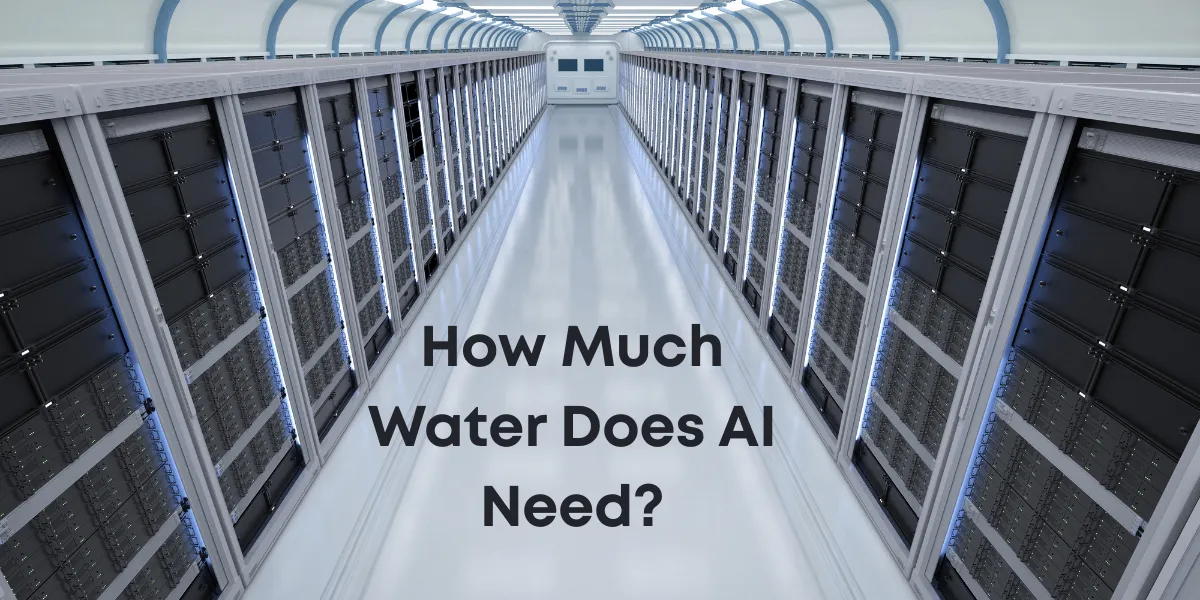

AI needs electricity, chips, and cooling to work. There is water behind each part. As AI grows quickly, it leaves a bigger water footprint in places like data halls, power plants, and chip fabs. In a few years, projections say that more than 1 trillion liters will be used each year. Big data centers use millions of liters of water every day. This guide breaks down the sources, the scale, and the solutions.
What counts as AI water use?
There are three main sources of AI water use:
- Direct withdrawals of cooling water for data centers on-site
- Electricity generation and indirect water use
- Water used to make semiconductors for GPUs and memory
These sources together define the AI water footprint and link AI’s effect on the environment, sustainability, and resource use.
How does AI use water?
Using water directly to cool data centers
Training and inference servers get hot. Evaporative or tower-based systems are used by facilities. The Water Usage Effectiveness (WUE) metric shows how many liters of water are used for every kilowatt hour. A common value is around 1.9 liters per kWh.
At 100 MW, the daily draw is often close to 2 million liters. The range of annual totals is between 0.7 and 2.5 billion liters, and the spread is caused by climate and design. Some hyperscale data centers use 18 to 20 million liters of water every day, which is about the same as a small town.
Water use, electricity, and manufacturing that isn’t direct
The hidden share is shaped by how power is made. Thermal plants take out a lot of water for steam and cooling. Solar and wind energy use a lot less water. Grids with a lot of thermal mix need more water for AI infrastructure because they use electricity to make water.
Water use in semiconductor manufacturing is also very high. Ultra-pure water is used for cleaning and lithography in advanced fabs. More orders for AI accelerators mean more withdrawals from upstream.
Scale and projections on a global level
Today’s global data center water use is expected to be more than 560 billion liters per year, and it could double by 2030. By 2028, AI-driven facilities alone are expected to use about 1,068 billion liters of water per year. The range of scenarios goes from 637 to 1,485 billion liters per year.
Depending on the size, data center efficiency, and power source, one model training run can use anywhere from 700,000 to 2.7 million liters.
What you do normal water use notes
Data center with 100 MW, around 2 million liters a day Changes are caused by the weather and design. A big hyperscale site can hold 18 to 20 million liters of water per day. Examples of the upper end Training a single large model takes between 0.7 and 2.7 million liters. Sites plus virtual water from power AI-powered DCs in 2028 will use 1,068 billion liters of water per year. From 637 to 1,485 billion
Examples from training the model
A research program that trained several modern models reported about 2.7 million liters over the course of the project. A previous large model training cycle used about 700,000 liters of water. The totals include both site withdrawals and virtual water from electricity. As inference traffic grows, withdrawals increase over time in many places.
Why this footprint is important
Stress in the area. Data centers tend to group together where electricity is cheap, which is often in dry areas. Heavy withdrawals put a lot of stress on farms and city supplies.
More general effects of AI on the environment. Water footprints are often hidden next to carbon reporting. Both are needed for full reporting. Risk of growth. Over the past ten years, there have been huge increases in GPT scale training and fast inference traffic.
Important point
AI already uses billions of liters of water each year for cooling, making electricity, and making things. Growth shows that things will get worse quickly if nothing is done. AI progress stays in line with sustainability goals thanks to strong metrics, cooling that uses less water, smarter siting, and low-water power.
Sources
- https://en.wikipedia.org/wiki/The_water_consumption_of_AI_data_centers
- https://www.eesi.org/articles/view/data-centers-and-water-consumption
- https://assets.publishing.service.gov.uk/media/688cb407dc6688ed50878367/Water_use_in_data_centre_and_AI_report.pdf
- https://economictimes.indiatimes.com/tech/artificial-intelligence/ai-data-centers-to-drive-11-fold-rise-in-water-consumption-by-2028-morgan-stanley/articleshow/123755912.cms
- https://www.aquatechtrade.com/news/digital-solutions/ai-water-usage
- https://arxiv.org/abs/2503.05804
- https://arxiv.org/abs/2304.03271
